Our history beings during old assyrian empire as wikipedia says not akkadian empire, even if we are their descendants it doesnt mean that their history is ours because other people who live for example in sumer might be the real descendants of the sumerians! Sure we interbreed with them, and sure we are mixed but it was thanks to the neo assyrians who wanted them ALL to be assyrians that this happended, we are also not babylonians because they lived south of mesopotamia and we live north!

You are using an out of date browser. It may not display this or other websites correctly.
You should upgrade or use an alternative browser.
You should upgrade or use an alternative browser.
Understanding assyrian history
- Thread starter Neta1991
- Start date

mrzurnaci
Active member
our actual history goes back to the Sumerians because the ancient Assyrians inherited alot of their culture.
history starts in Southern Mesopotamia with the Sumerians, living along with them were Semitic herdsman I believe. The Sumerians found the South more stable and innovated in farming. This farming grew the population and thus the first cities were made filled up with thousands of people.
Sumerians had the usual stuff civilization had: music, war, culture, architecture, all that.
A migrating people from the Levant (area of Western Syria, Lebanon, and Israel) called the Akkadians saw how stable Sumer was and settled there.
The Sumerian and Akkadian population became mixed over time. Both Akkadians and Sumerians spoke both languages. The Akkadians adopted the Sumerian religion while the Akkadian language became the dominant language. Eventually an Akkadian man from northern Mesopotamia (wasn't Assyria yet) named Sharukin (we call him Sargon) was able to take power, amass an army and expands the territory of Sumeria farther.
Akkadian empire
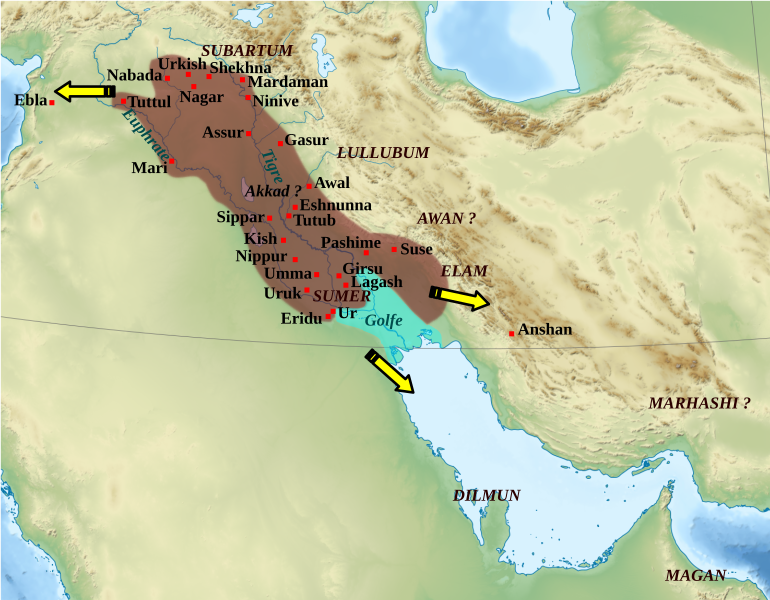
Even though Akkadian took over, Akkadian still had many Sumerian words and the empire used Sumerian as a religious and scientific language. Similar to how the modern world uses Latin as the scientific language now.
after a while, the Akkadian empire fell into a period of weakness and a Zagros people called the Gutians took advantage of the weakness to invade into Sumeria. The guti themselves took control for 50 years, their control was weakening each year and they eventually became part of the overall population.
The native Sumerians that were left overthrew the last Guti in control, this begins the period of the third dynasty of Ur. Like many other empires, after a period of peace and or bad leadership, the power of the third dynasty of Ur weakened. During this time, another Semitic people from the Levant called the Amorites also settled into Northern Mesopotamia then South and started to displace much of the Sumerians. It was then that the neighboring empire and rival of the Sumerians, the Elamites, overthrew the third dynasty of Ur.
Third Dynasty of Ur

After the fall of the third dynasty of Ur, Assyria itself became independent (archaeology records say Assyria was first). During this time, old Assyria was waging war against the Amorites to the South for control of Mesopotamia. The South was dominated by various Amorite states battling for control.
200 years after Assyria, an Amorite chieftain named Su-Abu had the eventually famous city of Babel built and named it as the capital of his territory. He is considered the first king of Babel even though he never called himself that. For over 100 years, Babylon was a weak state that was surrounded by more powerful countries like the Amorite states of Isin and Larsa, Assyria, and Elam.
This changed when an Amorite king named Hammurabi took control of Babylon. Babylon grew more powerful as Elam was able to destroy the local state of Eshnunna. In an attempt to make it easier to take Mesopotamia, Elam attempted to instigate a war between Hammurabi's Babylon and the state of Larsa; both Babylon and Larsa figured out this trick and went into an alliance to fight Elam.
After Elam was defeated and driven back, Hammurabi noticed that Larsa didn't put much effort into the alliance against Elam. Hammurabi was angry at this, invaded, and conquered Larsa. Hammurabi then turned his attention north and got into a long war with Assyria. both Babel and Assyria were building alliances with smaller states to fight the other side. In the end, Hammurabi was able to win and ousted the Assyrian king before Hammurabi died. The newer king of Assyria was forced to pay tribute to Hammurabi. Hammurabi was given the title "King of the Amorites" until his death. Hammurabi's son wasn't as good at leadership and Babel was quickly weakening as a state. An Akkadian vice regent named Puzur-Sin overthrew the remaining Amorite family of Babylon from power which sparked a period of civil war until the reign of Assyrian king Adasi.
Now starts the Middle Assyrian period and the Kassite control of Babylon but I don't want to type up our entire history. https://en.wikipedia.org/wiki/History_of_Mesopotamia
history starts in Southern Mesopotamia with the Sumerians, living along with them were Semitic herdsman I believe. The Sumerians found the South more stable and innovated in farming. This farming grew the population and thus the first cities were made filled up with thousands of people.
Sumerians had the usual stuff civilization had: music, war, culture, architecture, all that.
A migrating people from the Levant (area of Western Syria, Lebanon, and Israel) called the Akkadians saw how stable Sumer was and settled there.
The Sumerian and Akkadian population became mixed over time. Both Akkadians and Sumerians spoke both languages. The Akkadians adopted the Sumerian religion while the Akkadian language became the dominant language. Eventually an Akkadian man from northern Mesopotamia (wasn't Assyria yet) named Sharukin (we call him Sargon) was able to take power, amass an army and expands the territory of Sumeria farther.
Akkadian empire
Even though Akkadian took over, Akkadian still had many Sumerian words and the empire used Sumerian as a religious and scientific language. Similar to how the modern world uses Latin as the scientific language now.
after a while, the Akkadian empire fell into a period of weakness and a Zagros people called the Gutians took advantage of the weakness to invade into Sumeria. The guti themselves took control for 50 years, their control was weakening each year and they eventually became part of the overall population.
The native Sumerians that were left overthrew the last Guti in control, this begins the period of the third dynasty of Ur. Like many other empires, after a period of peace and or bad leadership, the power of the third dynasty of Ur weakened. During this time, another Semitic people from the Levant called the Amorites also settled into Northern Mesopotamia then South and started to displace much of the Sumerians. It was then that the neighboring empire and rival of the Sumerians, the Elamites, overthrew the third dynasty of Ur.
Third Dynasty of Ur
After the fall of the third dynasty of Ur, Assyria itself became independent (archaeology records say Assyria was first). During this time, old Assyria was waging war against the Amorites to the South for control of Mesopotamia. The South was dominated by various Amorite states battling for control.
200 years after Assyria, an Amorite chieftain named Su-Abu had the eventually famous city of Babel built and named it as the capital of his territory. He is considered the first king of Babel even though he never called himself that. For over 100 years, Babylon was a weak state that was surrounded by more powerful countries like the Amorite states of Isin and Larsa, Assyria, and Elam.
This changed when an Amorite king named Hammurabi took control of Babylon. Babylon grew more powerful as Elam was able to destroy the local state of Eshnunna. In an attempt to make it easier to take Mesopotamia, Elam attempted to instigate a war between Hammurabi's Babylon and the state of Larsa; both Babylon and Larsa figured out this trick and went into an alliance to fight Elam.
After Elam was defeated and driven back, Hammurabi noticed that Larsa didn't put much effort into the alliance against Elam. Hammurabi was angry at this, invaded, and conquered Larsa. Hammurabi then turned his attention north and got into a long war with Assyria. both Babel and Assyria were building alliances with smaller states to fight the other side. In the end, Hammurabi was able to win and ousted the Assyrian king before Hammurabi died. The newer king of Assyria was forced to pay tribute to Hammurabi. Hammurabi was given the title "King of the Amorites" until his death. Hammurabi's son wasn't as good at leadership and Babel was quickly weakening as a state. An Akkadian vice regent named Puzur-Sin overthrew the remaining Amorite family of Babylon from power which sparked a period of civil war until the reign of Assyrian king Adasi.
Now starts the Middle Assyrian period and the Kassite control of Babylon but I don't want to type up our entire history. https://en.wikipedia.org/wiki/History_of_Mesopotamia
mrzurnaci said:our actual history goes back to the Sumerians because the ancient Assyrians inherited alot of their culture.
history starts in Southern Mesopotamia with the Sumerians, living along with them were Semitic herdsman I believe. The Sumerians found the South more stable and innovated in farming. This farming grew the population and thus the first cities were made filled up with thousands of people.
Sumerians had the usual stuff civilization had: music, war, culture, architecture, all that.
A migrating people from the Levant (area of Western Syria, Lebanon, and Israel) called the Akkadians saw how stable Sumer was and settled there.
The Sumerian and Akkadian population became mixed over time. Both Akkadians and Sumerians spoke both languages. The Akkadians adopted the Sumerian religion while the Akkadian language became the dominant language. Eventually an Akkadian man from northern Mesopotamia (wasn't Assyria yet) named Sharukin (we call him Sargon) was able to take power, amass an army and expands the territory of Sumeria farther.
Akkadian empire
Even though Akkadian took over, Akkadian still had many Sumerian words and the empire used Sumerian as a religious and scientific language. Similar to how the modern world uses Latin as the scientific language now.
after a while, the Akkadian empire fell into a period of weakness and a Zagros people called the Gutians took advantage of the weakness to invade into Sumeria. The guti themselves took control for 50 years, their control was weakening each year and they eventually became part of the overall population.
The native Sumerians that were left overthrew the last Guti in control, this begins the period of the third dynasty of Ur. Like many other empires, after a period of peace and or bad leadership, the power of the third dynasty of Ur weakened. During this time, another Semitic people from the Levant called the Amorites also settled into Northern Mesopotamia then South and started to displace much of the Sumerians. It was then that the neighboring empire and rival of the Sumerians, the Elamites, overthrew the third dynasty of Ur.
Third Dynasty of Ur
After the fall of the third dynasty of Ur, Assyria itself became independent (archaeology records say Assyria was first). During this time, old Assyria was waging war against the Amorites to the South for control of Mesopotamia. The South was dominated by various Amorite states battling for control.
200 years after Assyria, an Amorite chieftain named Su-Abu had the eventually famous city of Babel built and named it as the capital of his territory. He is considered the first king of Babel even though he never called himself that. For over 100 years, Babylon was a weak state that was surrounded by more powerful countries like the Amorite states of Isin and Larsa, Assyria, and Elam.
This changed when an Amorite king named Hammurabi took control of Babylon. Babylon grew more powerful as Elam was able to destroy the local state of Eshnunna. In an attempt to make it easier to take Mesopotamia, Elam attempted to instigate a war between Hammurabi's Babylon and the state of Larsa; both Babylon and Larsa figured out this trick and went into an alliance to fight Elam.
After Elam was defeated and driven back, Hammurabi noticed that Larsa didn't put much effort into the alliance against Elam. Hammurabi was angry at this, invaded, and conquered Larsa. Hammurabi then turned his attention north and got into a long war with Assyria. both Babel and Assyria were building alliances with smaller states to fight the other side. In the end, Hammurabi was able to win and ousted the Assyrian king before Hammurabi died. The newer king of Assyria was forced to pay tribute to Hammurabi. Hammurabi was given the title "King of the Amorites" until his death. Hammurabi's son wasn't as good at leadership and Babel was quickly weakening as a state. An Akkadian vice regent named Puzur-Sin overthrew the remaining Amorite family of Babylon from power which sparked a period of civil war until the reign of Assyrian king Adasi.
Now starts the Middle Assyrian period and the Kassite control of Babylon but I don't want to type up our entire history. https://en.wikipedia.org/wiki/History_of_Mesopotamia
It really doesnt matter because we are the direct descendants of the ancient Assyrians, not sumerians. Marsh arabs might have more sumerian blood in them and might be the real descendants of Sumerians. We are mixed thanks to neo assyrians, if what you say is truth then they would include all of mesopotamian history about assyrian people history on wikipedia. Those people you mention is important to our culture. Like simo parpola said, ironically chaldeans are named after the people that destroyed the assyrian empire.
Okay first came Apes then sumerians, then akkadians, then they become sumerian-akkadians, then come Assyria,and now is when our real history begins and identity.
Ezidi Kurd said:All the Middle-Eastern people have some Sumerian ancestry to some degree. The question is how much. 1%, 2% or 3%, So, it is almost nothing. Aryan Sumerians migrated not only to the Southern Iraq, but actually also to the Arabian Peninsula and the Levant even way to India. It has been proven that the Sumerian farmers reached India.
But the point is that the ORIGINAL Sumerians came from the Zagros Mountains, from the Iranian Plateau (, like the Medes). The closest people to the ancient Sumerians and those who have the most Sumerian DNA are actually the Kurds.
HAHAHA your knowledge shows up there, assyrians and those living in southern iraq are the closets to sumerians. You kurds are the descendants of many people, mostly tribesmen. We brought civilization, what did you Do?
Ezidi Kurd said:What the hack are you talking about? The Aryan Sumerians from the North migrated into the Southern parts of the Mesopotamia. They brought civilization. Later on, those Sumerians were later replaced by uncivilized Semites. After Semites replaced the Sumerians, the high advanced Aryan culture started to decline. It is because of the Afro-Asiatic Semites that there was a decline of the civilization.
Aryan Sumerians from the mountains not only brought advanced civilization in Southern Mesopotamia, but also the Arabian Peninsula, the Levant, the Steppes, but also to the Indus Valley.
Sumerians who live in Shengal were more ancient than Sumerians who lived in Southern Iraq.
I've studied the Sumerians for more than 10 years.
My people ARE tribesmen, because the ancient ARYANS were tribesmen. The Aryan Medes had many tribes. Because of our tribal system, Kurds are the PUREST people of the Middle East. Tribal system and our religion saved and protected our race. I do belong to a great Ezdi Kurdish ARYAN tribe. And I'm very proud of it.
You Do understand that we are all related, we are all homo sapiens sapiens? There is no pure race
mrzurnaci
Active member
Nemrud said:You Do understand that we are all related, we are all homo sapiens sapiens? There is no pure race
Nemrud, just ignore him.
Mr. Tambourine Man
New member
Ezidi Kurd said:What the hack are you talking about? The Aryan Sumerians from the North migrated into the Southern parts of the Mesopotamia. They brought civilization. Later on, those Sumerians were later replaced by uncivilized Semites. After Semites replaced the Sumerians, the high advanced Aryan culture started to decline. It is because of the Afro-Asiatic Semites that there was a decline of the civilization.
Aryan Sumerians from the mountains not only brought advanced civilization in Southern Mesopotamia, but also the Arabian Peninsula, the Levant, the Steppes, but also to the Indus Valley.
Sumerians who live in Shengal were more ancient than Sumerians who lived in Southern Iraq.
I've studied the Sumerians for more than 10 years.
My people ARE tribesmen, because the ancient ARYANS were tribesmen. The Aryan Medes had many tribes. Because of our tribal system, Kurds are the PUREST people of the Middle East. Tribal system and our religion saved and protected our race. I do belong to a great Ezdi Kurdish ARYAN tribe. And I'm very proud of it.
If incest is a measure of purity than the Kurds are off the charts pure.

nejepnerast
New member
Mr. Tambourine Man said:If incest is a measure of purity than the Kurds are off the charts pure.
Insulting , but funny :mfr_lol:

Cascade
Well-known member
That, or the fact that he has Assyrian and a couple of Jewish ethnic groups (Georgian/Iraqi) in him. Lol.Mr. Tambourine Man said:If incest is a measure of purity than the Kurds are off the charts pure.